
In the last week of February 2022 it started raining over south-east Queensland and northern New South Wales, and it did not stop. Within weeks, Australian insurers were carrying nearly a quarter of a million flood claims from the costliest flood event in the country's history. Operations built for hundreds of lodgements a week were receiving thousands a day.
Now the second number, and it comes from an ordinary book on an ordinary Tuesday. On the claims portfolios we (Wilbur) have measured, the slowest tenth of the book holds close to half of all the waiting time, and that slow tail is dominated by a handful of perils: storm and water. The same perils that surge.
Wilbur, a claims management technology provider, reminds Australian insurers of the stress that policy holders and claims teams suffered during the last major floods2. El Nino will impact private and business customers around the world 3 4. North America, Europe and Asia whilst Africa will face droughts. And this is the most powerful El Nino for a long, long time that will peak in February. Siemesen looks at some of the adverse impacts of the 2022 floods from Wilbur's own records.
One claim, inside the surge.
A flood claim is lodged on the third day of a catastrophe event — one of nine hundred that arrive that day.
The customer lodges by phone after two hours on hold. Water reached a metre through the house. The call handler, a surge contractor on their fourth day, records the basics. No photos are requested; there is no process for it at this volume. Somewhere a triage queue grows.
No assessor has attended; there are not enough assessors in the country for this event, and the roads were closed for the first fortnight anyway. The customer does what any family must: strips the sodden carpet and plasterboard, hires a skip, starts drying the house. The evidence of the loss — water lines, contents, the state of the roof and drains before remediation — goes to landfill with the carpet.
An assessor attends a cleaned, gutted shell and records what remains. The question that will decide the claim — flood inundation or long-term seepage and maintenance — is now a matter of inference, because the scene that would have answered it no longer exists.
A hydrology report is commissioned. The handful of hydrologists in the market are carrying thousands of files; the report, when it arrives, is generic to the postcode rather than specific to the house. The customer has rung eleven times and had three different handlers.
Declined: unable to establish storm-related inundation, maintenance exclusions cited. The customer disputes. The dispute body reads a file whose central evidence was never captured, notes the report cannot link cause to conclusion, and overturns the decline.
Paid. Plus the complaint, the rework, the accommodation costs of the delay, and a family that will tell the story for a decade.
Siemsen says that whilst insurers can staff up beforehand the real problem lies with evidence which unless collected at the time of the loss will lack relevance, be old and incomplete and without validated provenance. The whole FNOL process must allow policy holders to register the losses immediately, collect evidence before it is lost, fill in the gaps that are identified, prove its provenance from FNOL to settlement in imutable audited records that will satisfy the most rogorous questioning by regulators and litigators. Most importantly, maintain trust and support of customers.
Another factor to test soaring claims for flashflood losses is the adoption of digital agents since 2022 and which I have written extensively about in ‘Claim Multi-Agent and Automated Intelligence Platforms Promise Automation Benefits — But Read the Fine Print on Autonomy’1. If you rely on agentic automated workflows and decisions you lay yourselves open to even worse outcomes.
Claims Management Systems (CMS) like Five Sigma and Wilbur that do include agents do so to augment claims teams and present them with timely, as complete as possible and proven evidence with scoring and help for those claims teams to make the right decisions and be able to uphold them throughout the life of the claim, however long the tail. Snapheet does not deploy agents but does have a highly configurable functionality to collect evidence.
If, as appears very likely, El Nino does stimulate flash floods, the surge in claims will most likely create another serious issue. Once the evidence gathering proceeds to the stage where the provenance of such evidence is good, will the claims team be able to review each recommended decision in time to process it or will they be tempted to invoke straight-though-processing (STP)? i.e. have agents make decisions to avoid bottlenecks. There are two issues to review: -
- Agents will lie, steal and cheat5 - proof of human authorisation and intent is vital to show resposnsible claims management
- The integration challenge between the dynamic data that a CMS like Wilbur, Five Sigma and Snapheet generates and the rigid taxonomy of the core system of record.
To tackle both issues an integration workflow via a compliance and trust layer is vital ; a simplified schema is shown below.
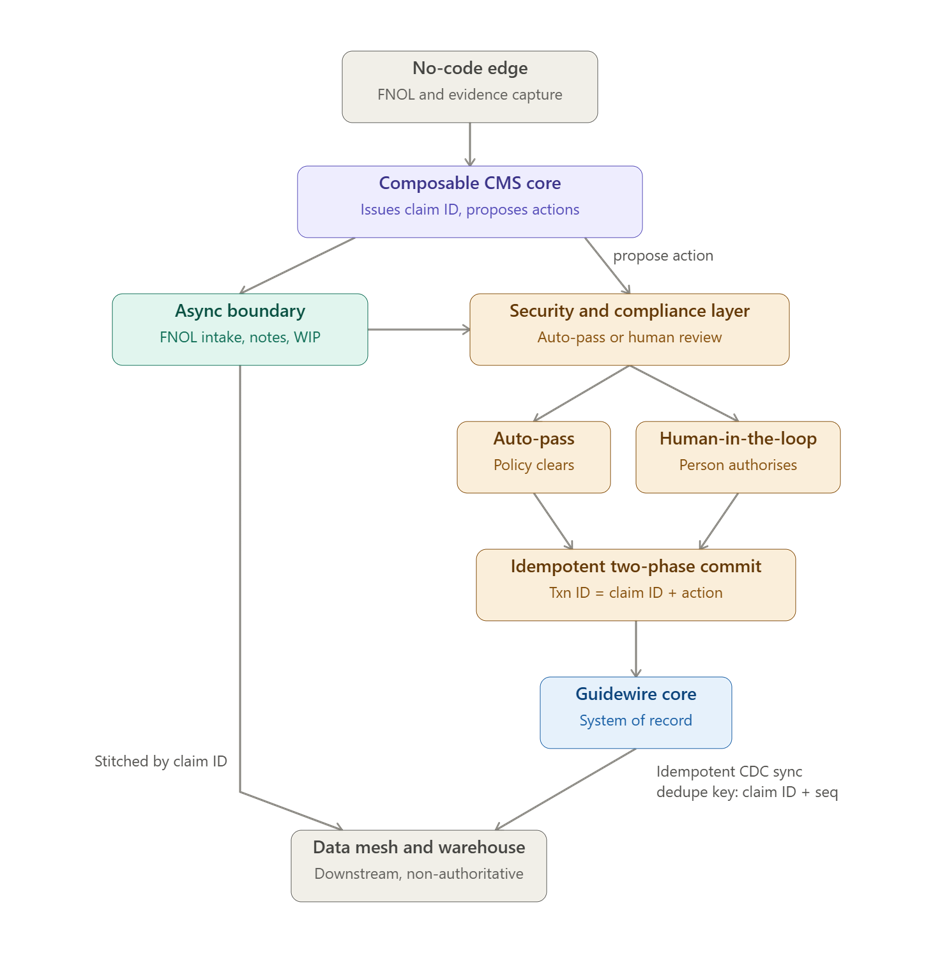
To plan and implement this however is a major matter involving the claims business, central IT, the CTO, CIO, CDO and other roles. It should also not be accomplished in isolation but as part of an overall project to leverage AIs across the whole insurance value chain. At the very least claims. counter-fraud and underwriting as all are so interlinked. Important to start now but not a few months project.
That security and compliance layer will in fact be multi-layer and to combat the dangers of multiple agents incorporate Neuro-symbolic AI integration that architecturality separates the agents in their run-time tier from deterministuic supervision. That will be the subject of another article.
For today and the immediate future human authorisation in the compliance and trust layer will stay critical for the El Nino season.
Agents are valuable to help collect and validate evidence but there are severe dangers of leaving them to flout goals and cover up tracks which is discussued in METR investigation of agents’ behavior, reasoning and collaboration in the OpenAI / Hugging Face hacking incident6
Flash flooding does not just involve buildings, contents, plant and machinery, contents but also injury, loss of life, vehicles, business interruption, marine and airhulls; the list is long. You need a CMS that delivers for all lines of business and not just one. However complex. evidence and the ability to act on it is the fundamantal requirement for customers and insurers of all kinds.
Frederik Bisbjerg CEO of Axxion (outsourced claims management company and CMS) has published a paper8 that is instructive on the current state of agents and human interaction; the use case is motor insuranbce but the pronciples hold good across all lines of business.
If your teams and systems were over-stressed during the last flooding and are still liable to overload then you need to pass the surge test that Siemsen helpfully provides using data from the last CAT event.
01 What was your lodgement multiple?
Peak week against baseline — and at what multiple does your intake stop capturing evidence and start just capturing contact details?
02 What was time-to-first-evidence on surge claims?
Versus the same perils off-surge. Count the files where the first structured evidence post-dates the start of remediation. That share is your inference exposure.
03 What did the surge cohort’s decision times and withdrawal rates do?
Against the same perils in ordinary months. If withdrawals climbed with the volume, the surge was deciding claims for you.
04 What share of surge denials survived challenge?
Overturn rates are the purest measure of whether decisions rested on evidence or on inference.
05 Could you evidence your surge performance to a regulator now?
File by file, under the critical-operation standard you are already subject to.
Ensure you get 5/5 before the rains come!As if that were not all- Patrick Kelahan added the broader issues that impact customers and insurers.
"El Nino's effects always cause focus on physical/weather outcomes and either different or amplified direct damage. Consider other aspects that are most often overlooked:
>Supply chain disruption- schedules and product availability.
>Raw materials' availability after a significant regional occurrence.
>Productivity reductions
>Government administration disruptions
>Business interruption/reduction effects on profitability
>Government resources inabilities to respond to unexpected regional events, e.g., flooding where flooding doesn't typically occur"
The other side of the El Nino coin is drought and wildfires. Europe has suffered these during the 2026 heatwaves and El Nino will cause droughts this winter. Rory Yates wrote about this recently in his regular adaptability newsletter7.
"First off, let’s make it clear. It is getting hotter and it is predicted to continue. Weather varies, but climate trends don’t.
And on that basis we are seeing a myriad of insurance issues continue to emerge.
As we get these more extreme drying conditions, for example, we get other impacts with things like subsidence. This is often counter intuitive to most people’s understanding of subsidence, which people have normally associated with wet conditions. However, prolonged dry weather and heatwaves shrink moisture-depleted clay soils, causing foundations to shift and triggering costly domestic property damage.
And according to the Association of British Insurers, home insurers paid out £72 million for UK domestic subsidence claims in the second quarter of 2026 alone, with average claims hitting a record £20,000."
Yates exhorts the industry to
"Fighting climate change relies on two main pillars: mitigation (stopping things happening) and adaptation (adjusting to unavoidable impacts).
In both these areas it’s absolutely in the insurers interest to act. Risk mitigation has been talked about for a long time, and it still has to form a key part of the next wave of change.
"Wether you think in frames like “predict & prevent” (Like Curtis Goldsborough aka Lo$$ Ratio) or you’re a reinsurer like Flood Re who looks to adaptation to mitigate risks by helping insurers build back properties so they are flood resilient and so on."
Link to full article in sources.
Sources
1 Claim Multi-Agent and Automated Intelligence Platforms Promise Automation Benefits — But Read the Fine Print on Autonomy Insurtech World
2. The Surge Test Wilbur
3. Catastrophe Losses Stay Below Average In H1 2026, But El Niño’s Impact Carries Hidden Risks Risk&Insurance
4. UN says "supersized" El Niño is coming. UK insurers may already be out of runway Insurance Business
5 AI agents lie, cheat and steal. That is putting off users The Economist
7 The Adaptability Newsletter Rory Yates
8 GenAI, control and humans in motor claims Frederik Bisbjerg
/Passle/5936d4a43d94760a145c92a7/SearchServiceImages/2026-10-07-15-47-10-738-6ac6697ea94b9e84e53c38fc.jpg)
/Passle/5936d4a43d94760a145c92a7/SearchServiceImages/2026-10-05-10-49-57-927-6ac380d5147a7b8e1ace985b.jpg)
/Passle/5936d4a43d94760a145c92a7/SearchServiceImages/2026-09-23-14-13-13-321-6ab3de7902670829c849ef1a.jpg)
/Passle/5936d4a43d94760a145c92a7/SearchServiceImages/2026-08-27-09-59-07-917-6a900a6b0a5b2aac932a8de4.jpg)